For \(n\in\mathbb{N}\text{,}\) we define \({[n]:=\{1,2,\ldots,n\}}\text{.}\) That is, \([n]\) is just clever shorthand for the set containing 1 through \(n\text{.}\) This notation is meant to resemble interval notation.
For \(k\in\mathbb{N}\) and a nonempty set \(A\text{,}\) a \(k\)-permutation of \(A\) is an injective function \(w:[k]\to A\text{.}\) The set of all \(k\)-permutations of \(A\) is denoted by \({S_{A,k}}\text{.}\) If \(A\) happens to be the set \([n]\text{,}\) we use the notation \({S_{n,k}}\text{.}\) And if \(n=k\text{,}\) we write \({S_n:=S_{n,n}}\) and refer to each \(n\)-permutation in \(S_n\) as a permutation. Let \({P(n,k):=|S_{n,k}|}\text{.}\) By convention, we set \({P(n,0):=1}\text{,}\) including the case when \(n=0\text{.}\)
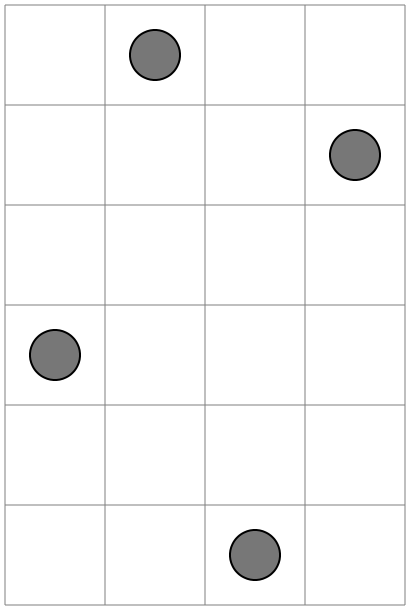
The game of chess is played on an \(8\times 8\) grid. We will consider chessboards with arbitrary dimensions, say \(n\times k\) (\(n\) rows, \(k\) columns) with \(1\leq k \leq n\text{.}\) A rook is a castle-shaped piece that can move horizontally or vertically any number of squares. In a typical chess game, there are two black rooks and two white rooks, but for our purposes we will assume we have \(k\) rooks, where all the rooks are the same color. We say that an arrangement of rooks on an \(n\times k\) chessboard is non-attacking if no two rooks lie in the same row or column. Figure 3.1 shows one possible non-attacking rook arrangement on an \(6\times 4\) chessboard.
Consider the collection of \(k\)-permutations in \(S_{n,k}\) with \(1\leq k\leq n\text{.}\) Explain why \(P(n,k)\) is equal to the number of non-attacking rook arrangements on an \(n\times k\) chess board. Hint: Establish a bijection between the collection of non-attacking rook arrangements on an \(n\times k\) chess board and the collection of \(k\)-permutations.
Recall that for \(n\in\mathbb{N}\text{,}\) the factorial of \(n\) is defined \({n!:=n\cdot (n-1)\cdots 2\cdot 1}\text{,}\) and we define \({0!:=1}\) for convenience.
We can think of a \(k\)-permutation as a linearly-ordered arrangement (i.e., string) of \(k\) of \(n\) objects. That is, we can denote a \(k\)-permutation as a string \(w=w(1)w(2)\cdots w(k)\text{,}\) where each \(w(i)\in [n]\) and \(w(i)\neq w(j)\) for \(i\neq j\text{.}\) For example, if \(n=6\) and \(k=4\text{,}\) then the string \(3624\) represents the \(4\)-permutation \(w:[4]\to [6]\) given by
In the case when \(n=k\text{,}\) we can denote a permutation as a string \(w=w(1)w(2)\cdots w(n)\text{,}\) where each entry \(w(i)\) appears once. For example, the string \(w=241365\) represents the bijection \(w:[6]\to [6]\) given by
If \(1\leq k\leq n\text{,}\) prove that \({P(n,k)=P(n-1,k)+kP(n-1,k-1)}\text{,}\) both using the formula in Theorem 3.3, and separately using the definition of \(k\)-permutations together with Product and Sum Principles. The latter approach is an example of a combinatorial proof.
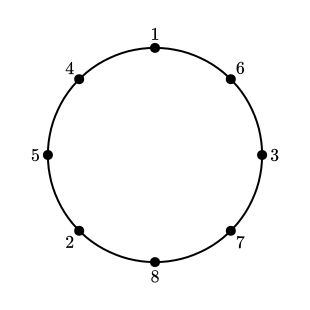
Interpreting a permutation as a linearly ordered arrangement of objects (i.e., string), a circular permutation is similar to a permutation except the objects are arranged on a circle, so that there is no beginning or end. An example of a circular permutation of length 8 is given in Figure 3.2. Any circular rotation yields the same circular permutation. However, for \(n\geq 3\text{,}\) reversing the relative order of the elements (i.e., encountering the same numbers counterclockwise instead of clockwise) yields a different circular permutation. Do you see why we included the restriction on \(n\) in the previous sentence?
We encountered circular permutations back in Problem 1.39 when we counted circular seating arrangements of six friends sitting around a circle to play a game. Recall that the trick in that problem was to make use of the Division Principle.
Moving away from circular permutations and back to \(k\)-permutations, recall that we can represent each \(k\)-permutation of \([n]\) as a string of length \(k\text{,}\) where each entry is from \([n]\) and no repeats are allowed. What if we allow repeats?
Consider a set of \(n\) objects that are not necessarily distinct, with \(p\) different types objects and \(n_i\) objects of type \(i\) (for \(i=1,2,\ldots, p\)), so that \(n=n_1+\cdots +n_p\text{.}\) An ordered arrangement of these \(n\) objects is called a generalized permutation and the number of such arrangements is denoted by \({P(n;n_1,\ldots,n_p)}\text{.}\) For example, the number of words we can make out of the letters of POPPY is \(P(5;3,1,1)\text{.}\) The following theorem follows immediately from the Division Principle.
Let’s revisit Problem 1.15, which involved my walk to get coffee. When we attacked that problem, we did a lot of brute force. Do we now have an easier method?