2026 Great Survival Debate
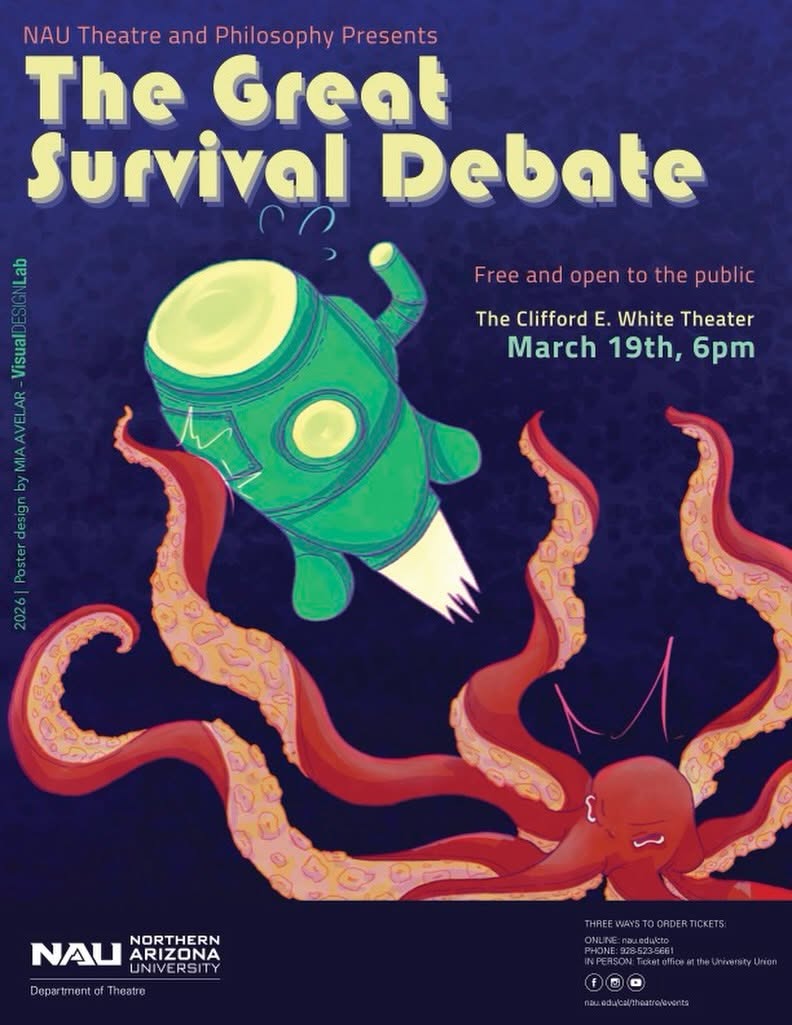
On Thursday, March 19, 2026, I participated in the NAU 2026 Great Survival Debate, which focused on a scenario where great upheaval has occurred and humanity clearly needs to set up a new world. Each debater was asked to argue that their area of study is the indispensable one that the new civilization must have to flourish. Since the theme fit into my broader mission of elevating the status of mathematics, I had no choice but to agree to play ball. Having never participated in such an event, I had no idea what to expect, but my aim was to have fun and give it my all.
There were a total of 6 debaters, representing anthropology, history, biochemistry, mathematics, electrical engineering, and philosophy. Each debater had 5 minutes for opening arguments and then we each had 2 minutes for rebuttal. I went 4th both times. During my 5-minute argument, I was reading from a script that I had produced the night before (but spent two weeks stressing about). I know my opening was far from perfect, but I’m really proud of what I came up with. I attempted to balance a serious tone with humor. Exercising my creativity in this way was pretty darn rewarding.
To my surprise, when all was said and done, I had managed to come out as the champion. Unanimous vote from the judges and the audience.
It truly meant a lot to me to see so many of my friends, students, and colleagues in the audience. What an awesome community we have! I care a lot about mathematics and I’m a proud mathematician. Given some of the recent challenges and battles I’ve endured as Chair, I felt like I/we needed a win and this felt damn good! But perhaps more importantly, I am heartened by the engagement and enthusiasm of the broader NAU community.
Below is the text of my opening argument. Someone also posted a video on Reddit, which you can watch here.
We stand at the Clifford E. White Theater not just to say goodbye to Earth, but to decide what defines the “human” in “humanity.” There is one seat left on the convoy. One. We are standing on the precipice of a new world. The biologists are trying to figure out how many jars of sourdough starter they can smuggle on board; the chemists are bringing… well, whatever it is they use to turn pond water into gin.
But if we want a civilization that doesn’t just survive, but flourishes, there is only one discipline that can claim the final seat on that convoy. It’s mathematics.
Most of you think mathematics is about calculations. You think it’s about balancing a checkbook or finding the slope of a line. Let me be clear: That isn’t math. That is arithmetic. If math were just calculation, we could bring a $5 calculator from the ruins of a 2024 Walmart and call it a day.
Mathematics is not about numbers; it is about ideas.
A mathematician’s goal isn’t to find x. It’s to grapple with the infinite and be immersed in the process of discovery. Repeatedly engaging in this process hones the mind. It develops a mental maturity marked by clear, rigorous thinking. It teaches you how to be wrong until, through the sheer force of logic, you are finally, undeniably right. Mathematics is the gym where the human intellect lifts weights.
Bertrand Russell once wrote, “Mathematics, rightly viewed, possesses not only truth, but supreme beauty.” It is a creative act. It is an art form. The painter’s medium is color and shape; the musician’s is sound and silence. A mathematician’s medium is abstract thought. We create cathedrals of logic out of thin air. Mathematicians are the poets of the invisible.
I see my colleagues looking nervous. And well you should be. Because, let’s be honest: most of your disciplines are just applied mathematics with more dirt and expensive equipment.
- Physics? That’s just mathematics with the “friction” setting turned on.
- Chemistry? That’s just mathematics where the variables occasionally explode.
- Engineering? That’s just math that occasionally falls down if you forget a decimal point.
- Computer Science? Yeah, just math with a keyboard.
You see, a biologist can run an experiment. They can poke a cell and see what happens. But without the underlying mathematical architecture, they are just “poking things.” Mathematics is the only discipline uniquely positioned to encode the intricacies of the universe.
Take, for instance, the process of fermentation. A chemist can watch the bubbles and hope for the best. A mathematician can encode the entire process into a framework that preserves the knowledge forever.
You might wonder: “Why waste a seat on a mathematician when a laptop can do a billion calculations a second?” Well… a computer is just a fast idiot. It does what it’s told. I am the insurance policy for when your hardware fails.
We are the language for documenting the universe. We are the “source code.” If you bring the chemist but leave the mathematician, you’re bringing the software but leaving the operating system.
We are going to a moon covered in ice. We are going to face problems we haven’t even thought of yet. How do we prepare for a problem that doesn’t exist?
We do it through abstraction. The seemingly most “useless,” abstract math—the stuff people laugh at for being “in the clouds”—is precisely what provides the breakthroughs when the world changes.
History proves this. Every “big” advance in our history started as abstract math. Google Search? Linear algebra.
Computers and AI? Built on the back of Boolean algebra and Turing’s logic. MRI machines? Born from the abstract geometry of Radon transforms.
Encryption? The only thing keeping Harold out of our group chats exists because of Number Theory—a field that 19th-century mathematicians bragged was “useless” because it was so pure.
If we want to ask and solve problems on Europa that the human mind hasn’t even conceived of yet, we need the toolkit of mathematics.
If you leave the mathematician behind, you aren’t just leaving a person. You are leaving the dictionary of the universe. You are leaving the ability to think clearly in the dark.
Every other discipline here is going to have to ‘re-learn’ their trade on Europa. But Euler’s identity? $e^{i\pi} + 1 = 0$? This is the same on Earth as it is on Europa! I am the only person on this stage whose entire body of work doesn’t need to be ‘updated’ the moment we touch down. I am the only one bringing a finished product.
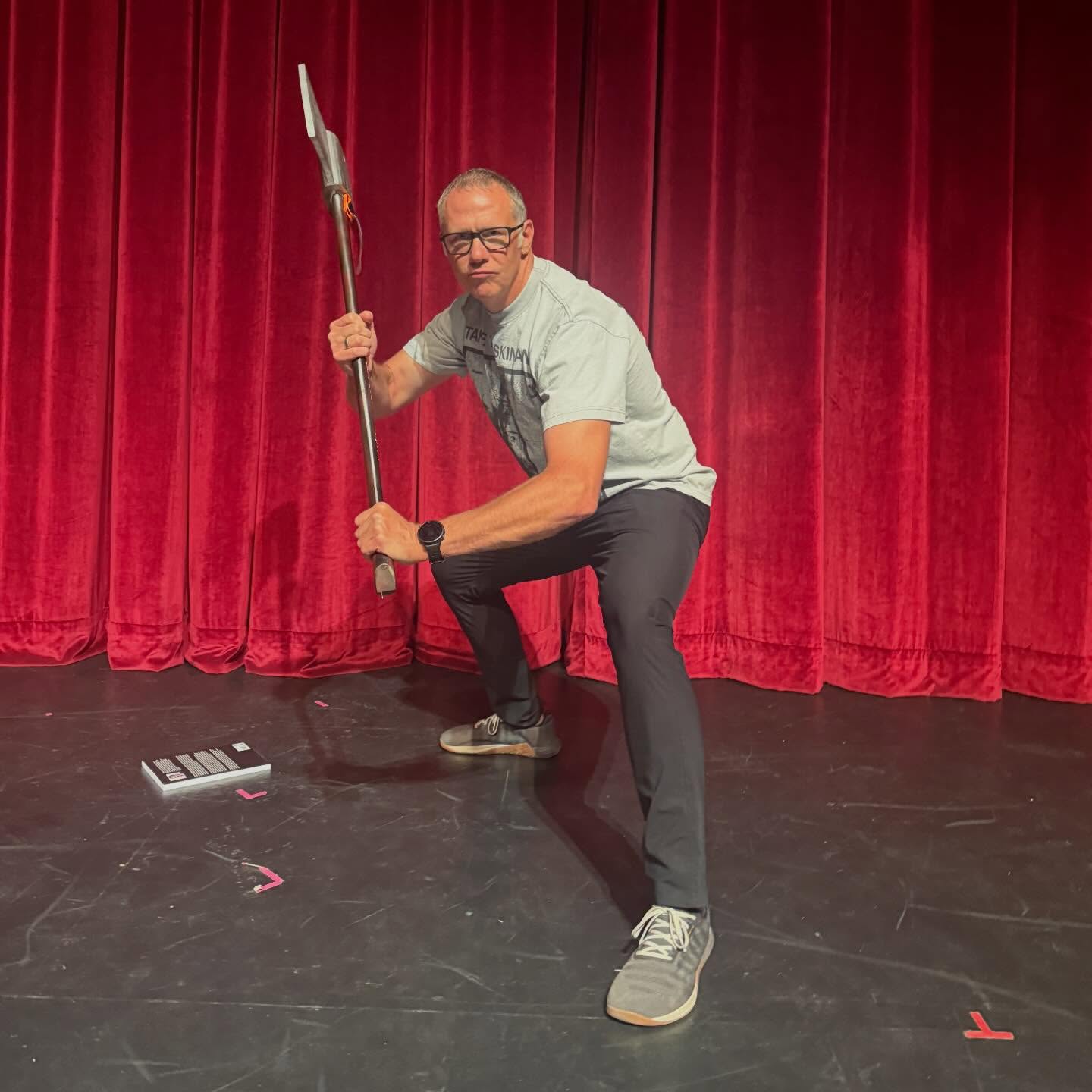
Give me that seat. Give me that axe. Thank you.
Thanks to all involved in creating a fun and entertaining event!
P.S. I apologize to all my fellow debaters for the digs. I love all the disciplines!
Dana C. Ernst
Mathematics & Teaching
Northern Arizona University
Flagstaff, AZ
Website
928.523.6852
Instagram
Strava
GitHub
arXiv
ResearchGate
LinkedIn
Mendeley
Google Scholar
Impact Story
ORCID
Current Courses
About This Site
This website was created using GitHub Pages and Jekyll together with Twitter Bootstrap.
Unless stated otherwise, content on this site is licensed under a Creative Commons Attribution-Share Alike 4.0 International License.
The views expressed on this site are my own and are not necessarily shared by my employer Northern Arizona University.
The source code is on GitHub.
Land Acknowledgement
Flagstaff and NAU sit at the base of the San Francisco Peaks, on homelands sacred to Native Americans throughout the region. The Peaks, which includes Humphreys Peak (12,633 feet), the highest point in Arizona, have religious significance to several Native American tribes. In particular, the Peaks form the Diné (Navajo) sacred mountain of the west, called Dook'o'oosłííd, which means "the summit that never melts". The Hopi name for the Peaks is Nuva'tukya'ovi, which translates to "place-of-snow-on-the-very-top". The land in the area surrounding Flagstaff is the ancestral homeland of the Hopi, Ndee/Nnēē (Western Apache), Yavapai, A:shiwi (Zuni Pueblo), and Diné (Navajo). We honor their past, present, and future generations, who have lived here for millennia and will forever call this place home.